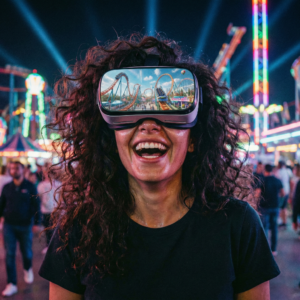
It is no secret that in recent years, the technology landscape has been rapidly evolving, giving rise to innovative concepts that are transforming how we interact with the digital world. Two concepts that have had a significant impact on this transformation—and are often compared, though fundamentally different—are Augmented Reality (AR) and Virtual Reality (VR). In some technical contexts, the distinction between AR and VR can be particularly important. In this article, we first discussed what Augmented Reality (AR) is and its applications, and then clarified the differences between Augmented Reality and Virtual Reality (VR).
What is Augmented Reality (AR)?

Augmented Reality (AR) It is a technology that overlays digital information such as images, sounds, or other data onto the real world. Unlike Virtual Reality (VR), which creates a fully immersive and interactive digital environment, Augmented Reality (AR) enhances the real world with digital elements that users can interact with. This is the main difference between AR and VR.
AR can be experienced through devices such as smartphones, tablets, or AR glasses. For example, imagine standing on a street looking for the way to an amusement park. Using AR technology, navigational elements can be overlaid onto the streets—you simply point your phone at the street, and the directions appear.
Another example of AR applications occurs while shopping. Using augmented reality, you can sit at home and, when buying a carpet, point your phone’s camera at the floor and virtually place the carpet design in the space to see how it looks.
How Does Augmented Reality (AR) Work?

AR systems work by using various technologies to integrate digital content with the real world. These technologies include:
Cameras and Sensors: Devices equipped with cameras and sensors detect and capture the physical environment. This input is then processed to identify objects, surfaces, or locations.
Processing Units: Data captured by the device hardware or cloud-based servers is processed. Advanced algorithms interpret the data and seamlessly integrate digital elements into the real world.
Displays: The processed information is then shown on the device’s screen or through AR glasses. These displays overlay digital content onto the view of the real world, allowing users to see and interact with both simultaneously.
Augmented Reality (AR) Applications:
Applications of Augmented Reality in Video Games: AR games, such as Pokémon GO, use augmented reality to blend virtual creatures with real-world environments, creating an engaging experience where players can interact with digital elements as if they were part of their surroundings. This technology has had a significant impact on the advancement of top VR games, adding new interactive capabilities and enhancing immersive gameplay experiences.

Applications of Augmented Reality in Education: AR can enhance learning experiences by providing interactive visual aids. For example, AR applications can overlay historical information onto real-world locations or visualize complex scientific concepts in a tangible way. This allows learners to overcome the limitations of traditional educational materials and engage more deeply with the subject matter.
Applications of Augmented Reality in Retail: Retailers use AR to allow customers to try products in their own homes. Applications that let users virtually try on clothing or see how furniture fits within their home décor are increasingly popular and continually improving, enhancing the shopping experience and helping consumers make more informed decisions.
Applications of Augmented Reality in Medicine and Healthcare: AR is used in surgical procedures to provide real-time overlays of vital information, enhancing precision and improving outcomes. It is also employed in medical education to simulate scenarios and practice various procedures, allowing trainees to gain hands-on experience in a safe and controlled environment.
Applications of Augmented Reality in Navigation: AR can provide directions and navigation information in real time. For example, it can overlay arrows and guidance onto street views or add information to buildings and obstacles, making it easier for users to find their way. This application is especially helpful while driving, as it assists drivers in navigating more efficiently and safely.
In contrast, Virtual Reality (VR) is a fully immersive technology that creates a completely digital environment separate from the real world. Users enter this environment through VR headsets or other devices that provide a fully immersive experience, often accompanied by spatial audio and interactive haptic feedback.
VR, or Virtual Reality, uses VR headsets equipped with displays and sensors that track the user’s head movements to create a 360-degree virtual environment that responds to the user’s actions. To interact with the virtual environment, users typically use motion controllers or gloves. These devices track hand movements and gestures, allowing users to manipulate objects within the VR space.
Virtual Reality provides an unparalleled level of immersion in games and entertainment. Players can experience worlds and scenarios that are entirely digital, ranging from fantasy games to realistic simulations, such as VR driving simulators.
VR is widely used for educational purposes in fields such as aviation, medicine, and the military (as discussed in the article on Virtual Reality applications in military industries). Simulations provide a risk-free environment where individuals can practice and enhance their skills. Simoto, as a producer of professional VR amusement park simulators, has been excelling for several years, and its VR simulator models continue to be developed and refined.
Virtual Reality is used in therapeutic settings to treat conditions such as PTSD, phobias, and anxiety. Controlled virtual environments help patients confront and manage their fears in a safe and regulated manner. Additionally, VR can provide significant support in educational activities, enhancing learning through immersive experiences.

Differences Between Augmented Reality (AR) and Virtual Reality (VR)
Application | Augmented Reality (AR) | Virtual Reality (VR) |
|---|---|---|
Interaction with the Environment | Augmented Reality enhances the real world by overlaying digital content. Users remain aware of their physical environment, with digital elements placed over their view of the real world. This experience focuses more on augmentation than interaction—manipulating the environment is not required in AR, and it is primarily used to enrich the user’s perception and provide additional information about their surroundings. | Virtual Reality provides a fully immersive experience. Users are completely placed within a digital environment, separate from the real world. This experience is designed to simulate a completely different reality, which can be described as a blend of the real and the virtual. |
Interaction with the Real World | In Augmented Reality, users interact simultaneously with the real world and digital elements. This technology is designed to seamlessly integrate digital content with the physical environment. | In Virtual Reality, users interact exclusively with the virtual environment. This technology creates a separate digital world, and during the experience, users have no direct interaction with their physical surroundings. |
Hardware Requirements | Augmented Reality can be experienced using smartphones, tablets, or augmented reality glasses. Hardware requirements are usually lower compared to VR, because AR relies on devices that users already have. | “Virtual Reality usually requires specialized hardware, including VR headsets, motion controllers, and sometimes external sensors. These devices are specifically designed to create and track an immersive and interactive virtual experience. |
Applications and Uses | Augmented Reality is often used in applications that enhance or complement the real world. Its use cases include gaming, navigation, education, and retail, where digital content adds value to real-world interactions. | Virtual Reality is used in applications that require full interaction within a digital environment. Its use cases include VR games, VR simulations, virtual tours, and more, where creating a completely separate virtual world is necessary for the experience. |
User Experience | Augmented Reality enhances the user experience by adding digital elements to the existing reality. It enables more seamless and continuous interaction with both the digital and physical worlds. | Virtual Reality provides a fully immersive experience that separates users from their real environment. It focuses on creating a convincing and interactive digital space where users can engage completely with virtual content. |
Future Trends and Developments | Future advancements in Augmented Reality technology may include greater integration with everyday objects, improved environmental awareness, and more advanced interactive capabilities. AR glasses are expected to become lighter and more sophisticated, providing a more natural and immersive experience. | The future of Virtual Reality may include more advanced haptic feedback, improved graphics synchronization, and more realistic simulations. As VR technology becomes more accessible and affordable, its applications in entertainment—such as VR amusement park rides—education, and remote collaboration are likely to expand. |
In summary, Augmented Reality (AR) and Virtual Reality (VR) are two distinct technologies that offer different ways to interact with digital content. AR enhances the real world by overlaying digital information, while VR creates a fully immersive digital environment. Understanding the differences between AR and VR helps in recognizing their unique applications and potential impact across various industries. As technology continues to advance, both AR and VR will play important roles in shaping our digital experiences and interactions.
By understanding these concepts, individuals and businesses can better leverage Augmented Reality and Virtual Reality technologies to create innovative solutions and experiences that push the boundaries of what is possible in our increasingly digital world.